Tacter: AI Match History & Analysis.
At Tacter, we built an AI-powered Match Review feature designed to work as a scalable in-game coach for Teamfight Tactics players.
The objective was to turn match data into actionable insights that improve player performance while creating a subscription-worthy product tied directly to the gameplay loop.
The Problem
Early signals showed technical feasibility, but weak adoption. The experience required two activation steps before users could access core value: account creation and summoner linking.
- 48.6% account creation rate
- 40.9% summoner linking rate
Many users still did not understand what Match Review was, why it mattered, or why they should generate a review after every match. The product was losing users before the first "aha" moment.
My Role
As Senior Product Designer, I led product design across funnel, activation, and review experience iteration.
- Analyzed funnel drop-offs and conversion bottlenecks.
- Redesigned onboarding, activation, and match history flows.
- Led weekly product iterations and rollout decisions.
- Measured impact and adjusted flows based on outcomes.
- Contributed to AI system prompt evolution through structured user feedback.
This was a continuous product iteration process, not a one-off redesign.
Solution & Process
Activation & Onboarding Redesign
The original onboarding had weak value communication, easy skip paths, and low friction in the wrong places. We redesigned the full flow so value was visible from the first step and activation became intentional.
- Value proposition surfaced first.
- Summoner linking moved earlier.
- Double-confirmation when trying to skip.
- Clearer copy and hierarchy.
- Less bypass of signup and linking actions.
ResultsSummoner linking improved from 40.9% to 63%, and account creation from 48.6% to 67.3%.
Then we shipped focused summoner-input improvements (explicit #Tag requirement, auto-detected region, and contextual helper text), pushing summoner linking to 72.6%.
Match History Redesign
The home was overloaded and unclear. We made a structural product decision: Match History became the new home. This increased exposure to the core review loop and made empty state behavior drive linking.
- Reduced cognitive load and simplified match cards.
- Highlighted review availability and generation states.
- Reduced card height for faster scanning.
- Made review CTA unmistakable.
ImpactWithout increasing total users, we reached 2x match detail views, 2x reviews generated, and around 50% conversion from detail view to review generation.
Improving AI Review Clarity & Engagement
User interviews showed three core issues: unclear insights, unclear generation status, and uncertainty about when a review was ready.
- Iteration 1: content simplification for faster scan and better hierarchy.
- Iteration 2: clearer CTA, free daily usage visibility, and a dedicated loading state with time expectations.
- Iteration 3: push notifications to close the loop while generation completes.
Because AI generation takes around 1-2 minutes, push notifications were essential. Review open rate increased from 30% to around 70%.
AI System Prompt Iteration
This was not only a UI effort. We built and iterated the AI system prompt with expert coaches and validated it after launch with 20+ users (coaches, creators, and competitive players).
Users reviewed real analyses and gave structured feedback on what was useful, unclear, misleading, or should be removed. I synthesized that qualitative input into prompt-level and UI-level improvements.
Across multiple cycles, we shipped major structural prompt updates plus smaller framing refinements, while adapting interface patterns to reinforce trust and comprehension.
Business Impact
72.6%
Activation
Summoner linking increased from 40.9% to 72.6% after onboarding and activation iterations.
2×
Core loop usage
Both match details viewed and analyses generated doubled through match history redesign.
~70%
Review open rate
Review open rate improved from 30% to roughly 70% with clarity + notifications.
2×
Return probability
Users who generated at least one review showed around 2x higher return probability.
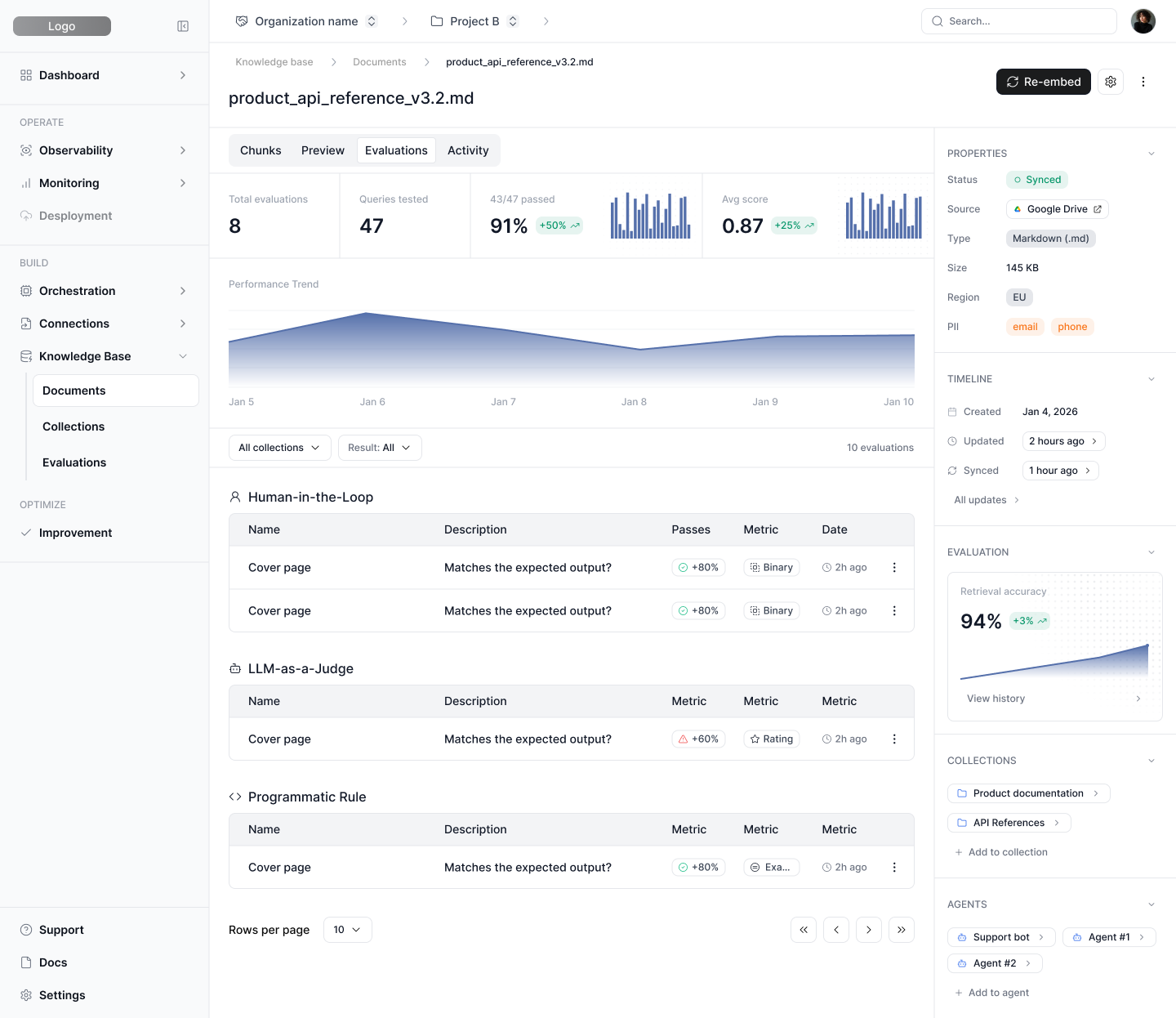

Document Detail Design for an AI IDE
A complex document workspace for AI workflows, designed in 2 days.